Wednesday, July 1, 2009

New Video from the Heavy: Something to Mull over while you 'Wait' for the New Album


So here's the deal. Everyone says the Heavy's Kelvin Swaby sounds a lot like Prince. It's the occasional falsetto, and the slithery-smooth but concomitantly crunchy backing of his band. As with any comparison, the truth is a bit more convoluted. On their debut album, Great Vengeance and Furious Fire, the then-coed brigade paid tribute to a lot more influences than just the one name-changing, bad-acting Mormon. The distant atmospherics of opener "Brukpocket's Lament" conjure an ambiguous indie film's rain-drenched climax scene; on "Dignity," the early-aughts "the" bands' calculated barbarism comes to mind, for better or worse; "Our Secret Place" is even harder-edged; "Who Needs the Sunshine" blends the vintage feel of an ancient soul b-side with the slow and nasty backbeat of a D'Angelo ballad.


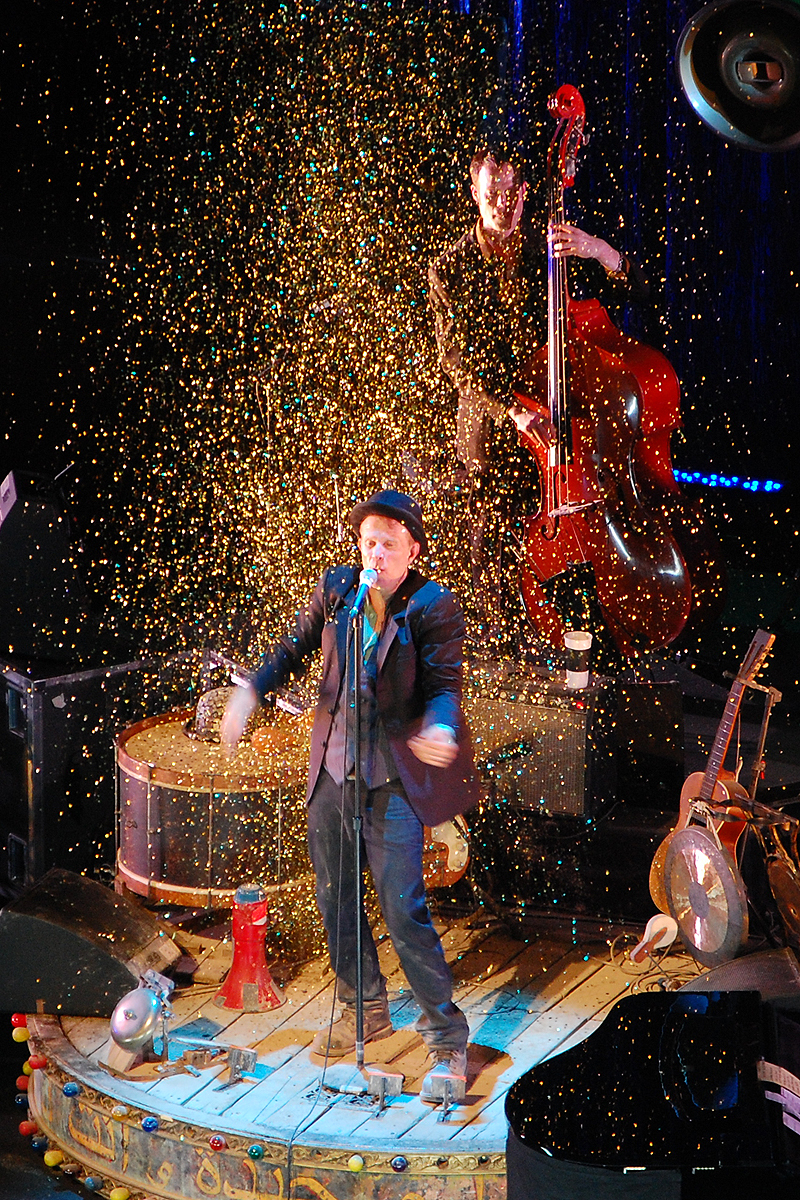
But did anyone see this one coming--a track that literally channels Tom Waits? That's what we've got for the lead single off these British Spin darlings' sophomore album, The House that Dirt Built. The verb "channel" isn't to be used lightly, but come on. That neo-New Orleans beat, the honking tuba doubled with the bass line, lyrics about the devil, and -- the icing on the tribute cake -- a video at Coney Island. If by any chance he's seen the video for "Sixteen," the carny-fied folk legend is probably having himself a raspy, cigarette-stained chuckle right now.

The main problem with the Heavy's music is that even when its apparent influences are wide-ranging or even ambiguous, the stuff usually manages to sound derivative. Still, there were plenty of bright spots on Great Vengeance, and "Sixteen" itself distills a good deal of Tom Waits' otherly intrigue along the way to, well, sounding a lot like him.

The House that Dirt Built is due out Oct. 6. That means we've got a lot of time to wait, which means a lot of time to milk that pun....

Wednesday, June 24, 2009

Live Review: Ezra Furman and the Harpoons 6.23.09


Calling all New Yorkers. If you are in this city and you haven't found time to hear Ezra Furman and the Harpoons perform, do yourself a favor.

The venerable indie-folkers will wrap up their residency at Piano's on Tuesday, and if they repeat their performance from yesterday night, many smiling faces will be heading for the exit at about 11:05 p.m.

The Harpoons vaulted through an hour-long set that was entirely as manic as Furman's gleeful howls. Even when he promised to play a slow song, that tune ended up being "God Is a Middle-Aged Woman," which in turn ended up being one of the loudest songs of the night, all gritty and pained – and painfully honest – but disarmingly goofy as well. While the guitar got dirtier and the drums got louder, he was gazing at the ceiling as he snarled, "Oh, God! / Won't you just say hello?" It's fair to say that when he was telling it, the sheepish and silly Furman took us places the Vatican – more to the point, your rabbi – never could.

But let's be honest: where the Harpoons' 2007 album, Banging Down the Doors, was a young thinking kid's folk gem, last night's concert was a lesson in the virtues of first-degree pop. Still, the band was as tight as it was carefree, and the background harmonies conjured irrepressible grins even – check that, especially – when they occasionally missed the mark. This foursome was on top of its game. Furman's thunderous acoustic guitar pulse, the top-of-the-beat intensity of drummer Adam Abrutyn, the swelling harmonica lines that Furman nailed–if you weren't listening to the lyrics of "Take off your Sunglasses," you might have thought it was the E Street Band minus the organ, playing "The Promised Land." Then again, if you were feeling a little less generous, you could also have thought it was a long-lost Tom Petty hit. The x factor rendering all these comparisons irrelevant? That was Furman's voice.

He tosses off effortlessly clever ironies and allegories of lovesickness with a whoop so filled with abandon it drowns out all those Dylan comparisons. It came as a bit of a disappointment that Furman didn't have time to kick the band offstage for a solo acoustic set ("American Highway" woulda been nice...), but I guess that's what the album is for. Last night's rock 'n' roll, little had I known, was for dancing.


Note: the photo is not from Tuesday's show. It is from his January 6, 2008 show at the Mercury Lounge in New York.

Monday, June 15, 2009

Time for the Boss to Pretend?

Bruce Springsteen reportedly put on a blowout performance at Bonnaroo yesterday, winning new converts in the heart of Tennessee. In addition to performing for almost three hours, the Boss joined Phish onstage and hung out with Okkervil River. Not surprising.

But let's be honest: did you really expect him to show up for the MGMT show? Does a guy who likes to "prove it all night" and "work all day in his daddy's garage" seem like he'd be game to "move to Paris, shoot some heroin and fuck with the stars"? Well, sure enough, it happened; check out the video above. Stranger things have happened, I guess....

Wednesday, June 3, 2009

Live Review: Akron/Family and Women 5.31.09


What better way to wrap up a five-month stint of cultural immersion in Bolgona, Italy, than by escaping to a tucked-away club outside of town for a concert by two North American bands no Italians have heard of?

Akron/Family and Women put on a blistering double billing at the Locomotiv Club here this weekend. Each band threw its recent album into the fire and cooked it Pittsburgh rare, until the sound and feel from the record turned scalding but stayed super-raw, putting a totally new taste in your mouth.

Women

Women opened up and quickly asserted that this show was as much theirs as Akron’s. Their brief self-titled debut album is a tube of tomato paste that you’ve left in the sun too long—highly condensed, and full of hazmat surprises. It’s rife with twists and turns and feels like a reference book of alternative influences. There’s the neo-naturalism of Grizzly Bear’s and Animal Collective’s old brands of freak-folk, manifested in a willingness to let an acoustic guitar and some co-oped vocals carry a piece, with the help of some trusty reverb (read: the first half of “Group Transport Hall,” featuring Women’s best melody). Women are at times industrial, at other times post-punky—as when their guitarists parlay an interface of two lightly distorted lines into a swirling cacophony à la Television. Often, the grittiness meets a sophisticated rhythmic sensibility that somehow propels the tunes ever forward, rather than halting and jerking them as Battles’ brand of math rock is wont to do.

Now imagine all this played by a band that listens to nothing but Fucked Up and My Bloody Valentine on the tour bus. At least that’s what it sounds like. Hiding from the drizzling rain beneath a tree outside the club after the set, I commented that the show was different from the record. “Yeah,” bassist Michael Wallace laughed. “Really different.” The song structures, even the instrumentation, stayed largely the same. But Women took their multidirectional vision, already steeped in lo-fi, and cranked up the volume to levels that (neighbors be grateful) can’t be reached in the basement. A friend who came with me to the show and who had hardly heard of Women before ended up calling their music “punk” and “hardcore;” meanwhile, I came away intrigued by the dejected, shoegazing quality that lead singer Patrick Flegel attached to his always distant vocals.

Check out this video of Women performing at CMJ last year via Pitchfork.tv:


Akron/Family

Akron/Family, now a three-piece after the 2007 departure of original member Ryan Vanderhoof, lived up to their reputation as a live powerhouse and one that sounds just as distinct from their recorded selves as Women do. Contrary to Allmusic’s oxymoronic attempts to pigeonhole – apparently “Akron/Family are one of those exasperatingly unknowable bands” but “their music … falls squarely into the freak folk category” – Akron concerts feel like exuberant explorations of the many directions in which their songs can be taken.

If I had to give it a genre, I’d call these New Agers’ style “freak-jam.” Songs like “Everyone Is Guilty,” the opener of impressive new album Set ‘Em Wild, Set ‘Em Free, swung about the spectrum of Akron’s sound. The trio jumped from a jaunty guitar groove to an intense communal chant of “Everyone is guilty” to a percussion-and-pedal section (different band members played a cowbell and a half-drunk water bottle and fiddled with a loop pedal); the tune eventually bloomed into a searing solo section.

The set closed with a simple ballad, sung in three-part harmony to the strumming of an acoustic guitar. The song’s only lyrics were, “Last year was a hard year for such a long time, / This year’s gonna be ours.” Although they did return for an encore of “Crickets,” the acoustic piece was a perfect capstone from this bearded threesome. The lyrics of their songs are effervescently positive and self-affirming, and at its best their music can feel like an unbounded spiritual release, sung in wild chants and deep, imperfect harmonies.


The photograph above is of Women's performance.

Friday, May 29, 2009

Animal Collective/Beach Boys Mash-Up


A while back, I spent some time comparing "Guys Eyes," from Animal Collective's Merriweather Post Pavillion, to the Beach Boys' "You Still Believe in Me," from Pet Sounds. It looks like somebody picked up on another similarity between "Guys Eyes" and a Beach Boys classic--this time, the link is even more inescapable. Check out this YouTube mash-up of "Guys Eyes" and "All I Wanna Do," from the largely forgotten gem, 1970's Sunflower.

Someone named Scott Karahadian seems to have had the idea, and after just one listen to the each individual tune, it's apparent why. The songs' opening lines are almost identical--and they're in the same key. Both bands go on to use characteristically lush vocals and sparse percussion; on "All I Wanna Do" the electric bass is what really keeps the pulse going, and the only consistent drumming comes from a lone snare.

The haunting similarities between Panda Bear and Brian Wilson aren't on display here, as Mike Love, Wilson's cohort turned nemesis, takes the lead vocals.

Tuesday, May 19, 2009

Look Both Ways #12: What Was I Thinking?


What was I thinking? If you've been wondering, I don't blame you. I've been drawing false lines around bands, tying artists together with ersatz thread, acting as if one group's music can possibly be defined as the offspring of one influential parent. In truth, each new song is no less than a singular brew culled from the reactive cauldron where every bit of music that's ever been heard resides. Even we, as human daughters and sons, are products of our surroundings, the languages we learn, the friendships we make, the sex and stock villains we see on TV, more than the genes we've been stuck with. If it were the other way around, Jakob Dylan and the Wallflowers might have really had something going for them. But alas, all we've got to hang on to is "One Headlight" and that catchy song where Adam Duritz wails his big old heart out on the background vocals.

When I set out this January to write a column tying one new album each week to a classic progenitor, I anticipated relatively smooth sailing. But early on, I found that it could be impossible to pair up a great new musician, no matter how "retro" he was, with a single forebear. In a piece about Raphael Saadiq's The Way I See It, an R&B record that seems to be obsessed with hearkening back, I couldn't find a single past album that would do it justice. I paired The Way I See It with a Motown hits collection, allowing myself to discuss an array of Saadiq's influences from the early days of soul.

In my article on Wynton Marsalis' new album blending spoken word and instrumental jazz, I didn't bother tying him to anyone else -- I compared the new He and She to an old Marsalis record with a similar bent. In my piece on King Khan and the Shrines, I had to spend a solid third of the article detailing my struggle to tease out the most appropriate reference point.

And for all the difficulty I've had deciding which old albums to highlight, what's to say a band's musical predecessors are its most important influences? Had I chosen to write about Inside the Human Body, Ezra Furman and the Harpoons' latest LP, I might have been better served tying it back to the literature courses Furman took while majoring in English at Tufts University, or to his favorite novel. After all, it's his glowing narratives and self-excoriating lyrics more than anything else that make him such an exciting new talent.

I think Stephen McBean of the band Pink Mountaintops has it about right. McBean told Stereogum last month that the group's newest record was influenced by "weddings in Montreal, winter, Pink Floyd's 'The Final Cut,' Christmas albums, that one Exile song and that one Echo and the Bunnymen song, the Bermuda Triangle, being depressed in the sunshine, people who haven't made out yet but will in the future, The Everly Brothers, clowns in the ceilings and bedrooms where skinheads used to live."

The best I can hope for, to quote Stephin Merritt, is that my comparisons' "truth or falsity is moot" because I've turned you on to some great new artists and maybe even a classic record or two that you'd never heard.

A version of this piece first appeared as a column in the May 17 issue of the Tufts Daily.

Sunday, May 3, 2009

Live Review: Bonnie 'Prince' Billy 4.29.09


It must be a chore to be loved by Will Oldham. For the very same reasons, it is spectacular to hear him sing his songs.

The Kentucky-bred musician drenches the glorified sentimentalism of country-western parlance in the corrosive waters of philosophical disquiet. His intellect and self-doubt would probably be endearing if they didn’t have that nasty habit of seeping outward, like a puddle of scalding coffee from a chipped mug. They attack all the things he dares to love, and warn him quietly: “Beware.”

Cloaked in blue-and-white striped overalls and the pseudonym Bonnie ‘Prince’ Billy, Oldham began Wednesday night at the Estragon in Bologna, Italy, with a series of relatively traditional saloon crooners. A stirring rendition of “You Don’t Love Me,” off his latest full-length, was an early highlight; Oldham and fiddler/secret weapon Cheyenne Mize called to each other in harmonies, at once wrenching and as sweet as funnel cake at the state fair: “You don’t love me, but that’s alright / ’Cause you cling to me all through the night.”

And then, somewhere about five songs in, the aircraft that’d been hovering in the ether over Dallas-Fort Worth International renounced the landing strip and headed for the stratosphere. With natural ease but fearsome adamancy, Oldham and his four-piece band careened into a set packed with equal parts summer love and hard-rock desperation—at times, the tempo changes and snare slams sounded about like a Liars concert would if a fiddler came in tow.

The passion that keeps Oldham on the avant-garde and pushing outward bursts from his pores in concert. He appeared to have situated the microphone six inches too low specifically so that he would have to contort himself to reach it, and when he put down his guitar for a few songs it was clearer than ever that he simply couldn’t pour everything he wished to into each song. He was left squirming and kicking and wrapping his black leather shoe around the back of his other ankle as he sang. On “Love Comes to Me,” he yelped and hopped between verses.

For all this helpless hungering, he was a man in control; there was a sureness in his eyes that he must have picked up at some point in the past 16-plus years of touring. I was convinced he had a towering stature until his roughly 5’8” frame sauntered up to the bar after the show.

In a thunderous depiction of “There Is Something I Have to Say,” Oldham cried out, “I feel deserving of love / Can it be something I dispose of / Or put away in a box under the bed?” It’s true that there is “I” splattered all over his lyrics. But simply calling Oldham a solipsist is as insufficient as calling him alt-country. For him, these are points of departure; where another musician might end a song, he and his band turn up the tempo and enter into a vicious call-and-response of guitar and fiddle and pounding drums. Where another lyricist might drown, poignantly enough, in his own sorrow, Oldham blends doubt with hope, hope with a vicious distrust, and then turns it all on the rest of the world. “And love will protect you / To the edge of the wood, / And a monster will get you / And love does no good,” he cautioned the flock of Italian-speaking spectators during “Even if Love.” And they believed him.

Note: the above photograph is not from Wednesday's concert; it was uploaded to Flickr on March 24, 2007, by user elspop :: concert photography.